Passive infrared thermography technique for concrete structures health investigation: case studies

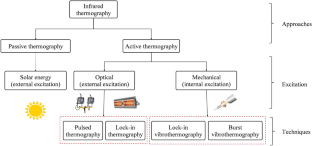
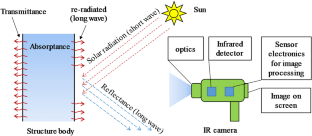
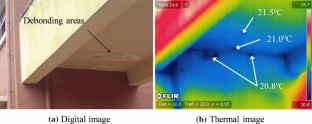
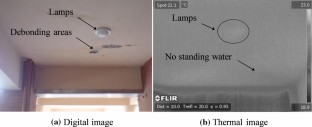
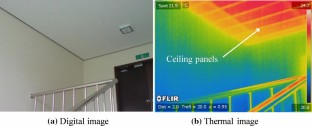
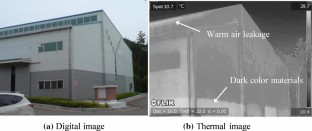
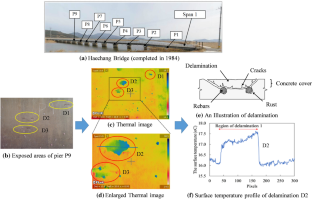
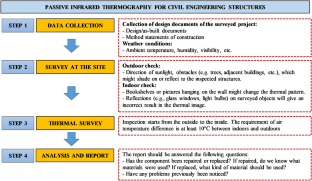
Non-destructive testing techniques are often employed for periodic maintenance and reparation of construction works, especially for large-scale structures. These techniques can be applied during construction or even on existing structures. Out of the non-destructive testing techniques, infrared thermography is a powerful technique to investigate structural conditions and locate the damages because of the ability to visualize unseen subsurface delamination through thermal images. The technology of infrared detectors has significantly developed with high-quality products and acceptable prices. Therefore, the applications of the technique are feasible. This article introduces current infrared thermography techniques. Case studies have been implemented using passive infrared thermography for investigating construction works, such as buildings, warehouses, and bridges. The study has elucidated the applications of the method in detecting moisture penetration, area of insulation, energy loss, and subsurface delamination. A guide to passive thermography has been recommended for site inspection. Finally, common errors during thermal surveying are discussed to help engineers reduce unnecessary mistakes.
This is a preview of subscription content, log in via an institution to check access.
Access this article
Subscribe and save
Springer+ Basic
€32.70 /Month
- Get 10 units per month
- Download Article/Chapter or eBook
- 1 Unit = 1 Article or 1 Chapter
- Cancel anytime
Buy Now
Price includes VAT (France)
Instant access to the full article PDF.
Rent this article via DeepDyve
Infrared Thermography Application in Buildings Diagnosis: A Proposal for Test Procedures
Chapter © 2013

Detection of Defects in Concrete Structures by Using Infrared Thermography
Chapter © 2021
Building Thermography: Detection of Delamination of Adhered Ceramic Claddings Using the Passive Approach
Article 18 November 2014
Availability of data and material
The data that supports the finding in this study are not publicly available. Any access request should be sent to huytq@ntu.edu.vn.
References
- American Concrete Institute. (2013). Report on nondestructive test methods for evaluation of concrete in structures. American Concrete Institute. Google Scholar
- ASTM D4580-03. (2007). Standard practice for measuring delaminations in concrete bridge decks by sounding. ASTM International. Google Scholar
- Castanedo, C. I., Genest, M., Piau, J. M., Guibert, S., Bendada, A. and Maldague, X. P. (2007). Chapter 14: Active infrared thermography techniques for the non-destructive testing of materials. in Ultrasonic and Advanced Methods for Non-destructive Testing and Material Characterization, World Scientific Publishing, pp. 325–348.
- Castanedo, C. I., & Tarpani, J. R. (2013). Non-destructive testing with thermography. European Journal of Physics,34(6), 91–109. ArticleGoogle Scholar
- Clark, M., McCann, D., & Forde, M. (2003). Application of infrared thermography to the non-destructive testing of concrete and masonry bridges. NDT&E International,36, 265–275. ArticleGoogle Scholar
- FLIR (2011) Thermal imaging guidebook for building and renewable energy applications, FLIR in cooperation with the Infrared Training Center (ITC)
- FLIR. (2012). The ultimate infrared handbook for R&D professionals. FLIR Systems Inc. Google Scholar
- FLIR SC660 Catalog. (2014). Technical data of FLIR SC660 infrared camera. FLIR System Inc. Google Scholar
- Holst, G. C. (2000). Common sense approach to thermal imaging, Bellingham. Spie Optical Engineering Press. BookGoogle Scholar
- IAEA (2002) Guidebook on non-destructive testing of concrete structures, IAEA in Austria.
- Kaveh, A., & Eslamlou, A. D. (2019). An efficient two-stage method for optimal sensor placement using graph-theoretical partitioning and evolutionary algorithms. Structural Control and Health Monitoring,26(4), e2523. ArticleGoogle Scholar
- Kaveh, A., Eslamlou, A. D., Rahmani, P., & Amirsoleimani, P. (2022). Optimal sensor placement in large-scale dome trusses via Q-learning-based water strider algorithm. Structural Control and Health Monitoring. https://doi.org/10.1002/stc.2949ArticleGoogle Scholar
- Mac, V. H., Tran, Q. H., Huh, J., Doan, N. S., Kang, C., & Han, D. (2019). Detection of delamination with various width-to-depth ratios in concrete bridge deck using passive IRT: limits and applicability. Materials,12, 3996. ArticleGoogle Scholar
- Maldague, X. P. (2001). Theory and practice of infrared technology for nondestructive testing. John Wiley & Sons. Google Scholar
- Maldague, X., Galmiche, F., & Ziadi, A. (2002). Advances in pulsed phase thermography. Elsevier-Infrared Physics & Technology,43, 175–181. ArticleGoogle Scholar
- Maser K.R. (2009). Integration of ground penetrating radar and infrared thermography for bridge deck condition evaluation. In NDTCE'09, Non-Destructive Testing in Civil Engineering, Nantes, France
- Milovanović, B. and Banjad Pečur, I. (2011). The role of infrared thermography in nondestructive testing of civil engineering structures. MATEST 2011 Proceedings / Krnić, Nikša (ed). - Zagreb.
- Pailes, B. M., & Gucunski, N. (2015). Understanding multi-modal non-destructive testing data through the evaluation of twelve deteriorating reinforced concrete bridge decks. Journal of Nondestructive Evaluation. https://doi.org/10.1007/s10921-015-0308-6ArticleGoogle Scholar
- Pollock, D.G., Dupuis, K.J., Lacour, B. and Olsen, K.R. (2008). Detection of voids in prestressed concrete bridges using thermal imaging and ground-penetrating radar. WSDOT research report.
- Prakash Rao, D. S. (2008). Infrared thermography and its applications in civil engineering. The Indian Concrete Journal, 41–50.
- Tran, Q. H. (2021). Passive and active infrared thermography techniques in non-destructive evaluation for concrete bridge. In AIP Conference Proceedings 2420, 050008 (2021), Ho Chi Minh.
- Tran, Q. H., Huh, J., Kang, C., Lee, B. Y., Kim, I.-T., & Ahn, J.-H. (2018a). Detectability of subsurface defects with different width-to-depth ratios in concrete structures using pulsed thermography. Journal of Nondestructive Evaluation,37(32), 1–10. Google Scholar
- Tran, Q. H., Huh, J., Mac, V. H., Kang, C., & Han, D. (2018b). Effects of rebars on the detectability of subsurface defects in concrete bridges using square pulse thermography. NDT and E International,100, 92–100. ArticleGoogle Scholar
- Vollmer, M., & Mollmann, K. P. (2010). Infrared thermal imaging—fundamentals, research and applications, Veinheim. Viley-VCH. BookGoogle Scholar
- Washer, G. (1998). Developments for the non-destructive evaluation of highway bridges in the USA. NDT&E,31(4), 245–249. ArticleGoogle Scholar
- Więcek, B. and Poksinska, M. (2006). Passive and active thermography application for architectural monuments. QIRT Journal, vol. 8th
Acknowledgements
Grants supported this research funded by Nha Trang University (No. TR2020-13-23), Korean government (MSIT) (No. 2021R1A2C1005587) and the contributions of the research team members in the SA-NDE-T Lab at the Civil Engineering Department of Nha Trang University.
Funding
The authors have not disclosed any funding.
Author information
Authors and Affiliations
- Department of Civil Engineering, Nha Trang University, 57000, Khanh Hoa, Vietnam Quang Huy Tran, Quoc My Dang, Xuan Tung Pham, Thanh Chung Truong & Thang Xiem Nguyen
- Department of Architecture and Civil Engineering, Chonnam National University, Gwangju, 61186, Korea Jungwon Huh
- Quang Huy Tran
